How to Send Documents to Mexico from the US for a Property Closing
Packaging, the correct customs declaration, carrier transit times, and the Mexican address details that hold up a real estate closing.

By Rahul Bohara, founder of Shipbird. He runs our Austin hub.
If you're closing on a property in Mexico, whether it's a condo in Puerto Vallarta, a lot in Tulum, or a house near Lake Chapala, at some point a notario público or a title company is going to need an original, wet-ink document that can't be emailed. A signed deed, a fideicomiso instrument, a special power of attorney limited to the transaction, closing instructions your US attorney drafted. Whatever it is, it has to travel as paper, and the shipping part is where a lot of otherwise-smooth closings lose a week they didn't need to lose.
Quick answer: Package the document in a rigid mailer without taping over any seal or signature, declare it on the customs form as Documents / Business Papers of No Commercial Value at a $0 value, include the recipient's 5-digit código postal and colonia, and ship it on a discounted FedEx Express rate through Shipbird's Envelope service. No account and no boxed shipment required.
The legal step comes before the shipping step
Before you package anything, confirm what the receiving notario actually requires. Mexico is a member of the Hague Apostille Convention, so a document executed in the US and destined for use in a Mexican legal proceeding often needs an apostille from the Secretary of State in whichever state it was signed or notarized, but "often" isn't "always": the exact requirement depends on the state, the specific notario's office, and what the document is being used for. Some closings accept a US notarization alone; others won't proceed without the apostille attached.
This is a question for your attorney or the notario handling the transaction, not a shipping question, and getting it wrong costs far more time than any courier will. Nothing here is legal advice. It's about what happens to the envelope once the legal work is done.
Package, seal, and address it
- Make a copy of everything before you seal the envelope. If a page goes missing or customs holds the shipment for review, this is the only record of exactly what you sent and in what condition.
- Use a rigid or reinforced document mailer, not a soft envelope. A property closing package is often several pages stapled or bound together, and a flat mailer keeps signature pages and any embossed notary seal from creasing in transit.
- Don't add tape, staples, or a paperclip through a signature block, notary seal, or apostille. If the pages need to stay together, clip them somewhere clear of any stamp; a notario reviewing the document is going to look closely at exactly that spot.
- Write the full recipient name and address on the mailer itself, not just on a label that can peel off, matching the notario's or title company's office name exactly as it appears on their letterhead, since Mexican offices often go by a formal registered name that differs from how people refer to them casually.
- Seal every edge. A loosely sealed mailer carrying a real estate closing document is exactly the kind of shipment a customs officer opens by hand to inspect, which adds days you don't have on a closing timeline.
Carrier breakdown: DHL, FedEx, and UPS
All three major carriers move documents into Mexico quickly, since it's a short haul, and the transit-time gap between services is smaller here than on longer international routes.
| Carrier | Typical transit, US → Mexico | Notes |
|---|---|---|
| FedEx International Priority | 1–3 business days | Fastest of the three on most US-Mexico routes; what Shipbird's discounted Envelope rate runs on |
| DHL Express Worldwide | 1–3 business days | Comparable speed, strong coverage across Mexico City, Jalisco, and the Riviera Maya |
| UPS Worldwide Saver | 2–5 business days | Usually the slower of the three, though the border proximity narrows the gap versus overseas routes |
For a document this light, shopping three carrier sites for the cheapest rate that particular week rarely saves enough to justify the time, especially with a closing date on the calendar. That's the specific gap a wholesale rate on one carrier closes: a predictable price on a fast service, without re-checking three sites for one envelope.
Declare it correctly, or expect a hold
A signed deed or fideicomiso document isn't merchandise, but the customs form doesn't know that unless you say so. Declare the shipment as "Documents / Business Papers of No Commercial Value" with a declared value of $0. Writing an arbitrary dollar amount, leaving the value blank, or describing it vaguely as "legal papers" or "contract" is what gets a shipment reclassified as a commercial import, which means a commercial invoice requirement, a duty assessment, and a hold until it's sorted out. None of that should apply to a document with no resale value, but only if the paperwork says so clearly from the start.
Address details Mexican customs and couriers actually check
Three details cause more delays on this corridor than everything else combined:
- The 5-digit código postal, and nothing shorter or padded to look like a US ZIP code. Every regional sorting hub in Mexico routes off this number, and a wrong or truncated one is a fast way to land in the wrong city.
- The colonia (neighborhood). Mexican addresses treat the colonia as a required line, not an optional one the way a US address treats a neighborhood name. Leaving it off or folding it into the street line confuses both the courier's routing system and the local delivery driver.
- An active recipient phone number, with the country code. Notario offices and title companies are businesses, and FedEx and DHL both use the number to confirm delivery and coordinate signature requirements on a document this important. A missing number is one of the more common reasons a delivery attempt fails on the first try.
If the office is in a smaller municipality rather than a major metro, double-check whether they list a specific suite or floor. Larger notario offices share buildings with other practices, and a generic street address alone can leave a courier guessing at the door.
Where Shipbird fits
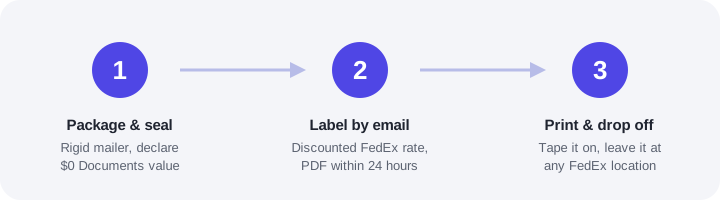
A closing document never needs to touch Shipbird's Austin hub, and for something this time-sensitive, you don't want it to. Envelopes is built for exactly this: flat documents up to 1 lb, shipped straight from your own US address on Shipbird's discounted FedEx Express rate, with no account required. Enter both addresses, get an instant quote, and pay once. There's no Shipbird handling in between. The shipment moves direct, on DAP terms, so any destination duties or clearance (rarely an issue on a $0-value document, but still) are handled between FedEx and the recipient, not routed through Shipbird.
The label lands in your inbox as a PDF within 24 hours of paying — not instantly, since it's prepared by hand against Shipbird's own FedEx account, which is what keeps the rate below what you'd pay at a retail counter. Print it, tape it to your mailer, and drop it at any FedEx location.
Get an instant quote for your document →
If you're shipping something heavier alongside the closing paperwork, such as a full file of supporting documents, bound materials, or anything over a pound, that's a job for Package Forwarding instead, since Envelopes is scoped to flat, sub-1-lb documents only.
Frequently Asked Questions
Do these documents need an apostille before I ship them?
Often, yes, if the document was executed in the US and needs to be presented to a notario público or Mexican registry. It depends on the state, the notario's requirements, and what the document is for. Confirm with your attorney or the notario handling the closing before you package anything; this isn't legal advice, and getting the attestation wrong is a much bigger delay than the shipping.
What customs value should I declare on closing documents to Mexico?
Declare it as Documents / Business Papers of No Commercial Value with a $0 declared value. A deed, a signed contract, or fideicomiso paperwork has no resale value, and putting a dollar figure or a vague description on the form is what tends to trigger a commercial hold.
How long does it actually take to reach Mexico from the US?
Transit alone typically runs 1 to 3 business days on FedEx International Priority for most of Mexico, given the shared border. Add label prep time on services that don't print instantly, and 2 to 4 business days door to door is a realistic total.
See what it'll cost to ship
Up to 80% off FedEx list shipping to Mexico. Get a live estimate on the calculator.
Want more guides like this in your Google results?
Add Shipbird on Google